Origin Stories and Medicine-Music
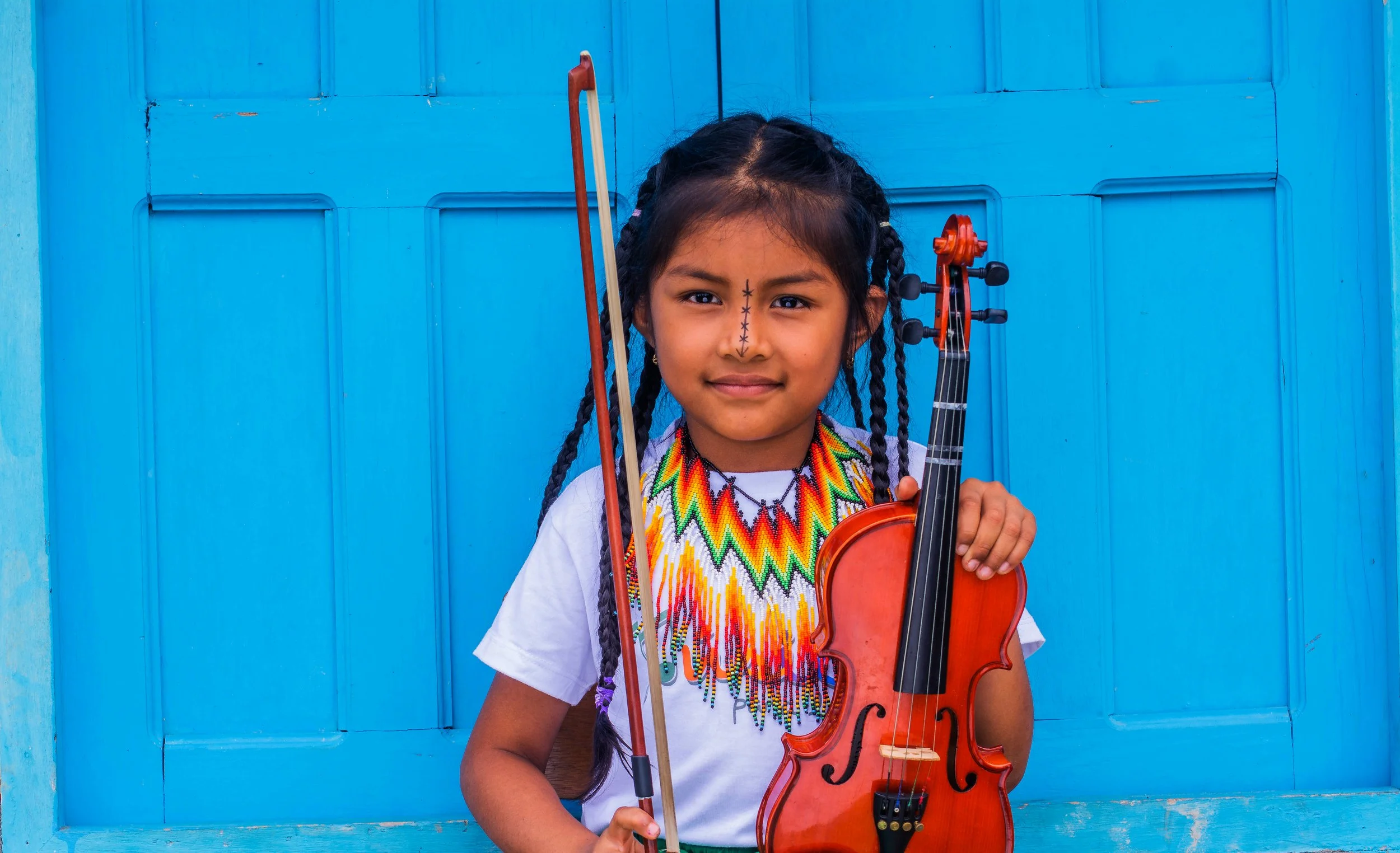
The Emberá Chamí Philharmonic
“Dachikacuade Ibana ume, unu sidama … two children came near that lake to see their reflection in a magical mirror…” This is how La voz de la Jaibaná (The Voice of the Jaibaná) begins, a composition that pays tribute to one of the good and healing spirits of the Emberá Chamí, an ancestral people who inhabit Colombian territory, who resist and refuse to disappear. For them, their entire environment is medicine: the plants, the fruits, fire, and the rivers. Music, being born from the inner nature of the human being, is healing as well. They believe in the spirits of all elements: “grandfather fire, mother water” and in the great spirit. Their history is transmitted orally through stories about the origin of the world, the elements that comprise it, and its inhabitants. Furthermore, everything they think and everything they dream is transformed into songs. Medicine-music and origin stories are used in ceremonies to invoke and heal; their use is sacred.
We might imagine these musicians and storytellers playing pan flutes, seed rattles, and drums. However, for the past 3 years, the Emberá Chamí community of Valparaíso – Antioquia, has also been pouring its culture and knowledge into violins, flutes, and trumpets through the Emberá Chamí Philharmonic. This symphonic orchestra is made up of 50 children from the community, belonging to an indigenous reserve of 400 inhabitants, which was born thanks to the union of the Fundación Música para la Paz (Music for Peace Foundation) and the Fundación Pasión y Corazón (Passion and Heart Foundation).
The Pedagogical Model and Cultural Preservation
Alejandro Vásquez Mejía, founder of Pasión y Corazón, explains that his foundation creates symphonic orchestras based on the Venezuelan teaching model. Beyond the pedagogical innovation this model introduced, it allows access to music education as a democratic alternative, despite the lack of instruments, study booths, accessories, or teachers. As in most projects of this type, limited resources are optimized to the maximum to provide the greatest possible coverage to the beneficiaries, conducting collective classes, sharing instruments among several children, etc. The orchestras adapt to the resources and needs of the territory and the community.
Thus, under this premise, the Emberá Chamí Philharmonic is dedicated to the rescue and projection of its culture: its medicine-music, its origin stories, and its native melodies and rhythms. In fact, 80% of the repertoire performed by the orchestra is based on their own music and the Emberá language. Sometime ago, the community had decided to open up to the capunías (non-indigenous people) to share their ancestral songs as “healing mantras”. However, they emphasize that their true interest is to preserve and strengthen their own culture. They consider that the project arrived at the exact moment to align with the community's desire to bring their songs to the rest of the world to expand their healing powers. In this way, the songs have also begun to be recorded, making the orchestra itself a heritage conservation project.
Displacement, Settlement, and Community Strength
The Emberá Chamí have had no better fortune than most ancestral peoples who have been cornered by the internal conflict in Colombia. Victims of forced displacement, they have been forced to abandon their territories on multiple occasions due to pressure from different armed groups; for many years they have been nomads without a choice. According to Colombia's Victims Unit (Unidad para la Atención y Reparación Integral de las Víctimas), 80,500 cases of individuals who have been the “target of victimizing acts against indigenous peoples” have been registered.
The current reserve in Valparaíso, from which the orchestra was born, became the place where this community managed to settle in a territory designated by the state just over a decade ago. They express that:
“What we seek is not just a place to live; we want to build our community, our traditions, our language, our way of dressing, our environment.”
On the indigenous reserve, they live the lives of peasants: they work the land, produce panela, market crafts, and at the same time, some of their members have already graduated from university and are teachers. All those who have managed to get an education state that their intention is to protect and develop their culture. The arrival of music teachers and instruments is no exception; it is a platform, an opportunity to share the best of their knowledge and ancestral power with others.
Global Connection and Social Impact
The community is open internationally and is in contact with Chilean and Mexican indigenous peoples, exchanging songs, rituals, and instruments, inspiring and supporting one another. The Emberá Chamí reaffirm that they are a non-violent community, and the Philharmonic is one of their greatest sources of pride. The mothers feel that their children “are receiving the opportunities that any other child in the world could receive”. Meanwhile, the project leaders laugh at the arrogant view that violins are better than pan flutes, stating that by utilizing a symphonic formation, they are merely accessing the timbral tools and technical resources an orchestra provides.
This is truly a community development initiative with a major social impact that proposes the empowerment of the Emberá culture, once again demystifying the symphonic ensemble, opening it up, and making it inclusive. They highlight the project as a means to make their talent and potential known to Colombian society and the world, as well as their resistance and struggle to survive.
